2027: Is PDP collapsing because Wike is ‘holding it down’ for Tinubu or due to internal crisis?
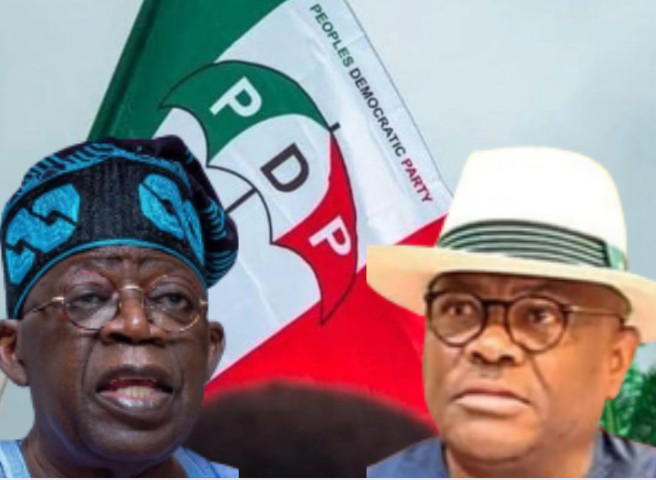
PDP Faces Internal Strife Amid Legal Rulings
By Luminous Jannamike, Abuja
A small kiosk situated near the busy junction of the Peoples Democratic Party (PDP) national secretariat in Wuse Zone 5 serves as a reflection of the party’s current state. Musa Sani, the kiosk operator, noted that while he has an abundance of unused campaign posters from the February 21 Federal Capital Territory council elections, enthusiasm among party members appears to be waning.
“We printed plenty, but the excitement was not there like before,” Sani remarked as he displayed the vibrant, yet untouched, PDP posters.
Internal Crisis Intensifies
The internal discord within the PDP reached a critical point following a recent Court of Appeal ruling in Abuja which upheld a previous Federal High Court decision that annulled the controversial national convention held in Ibadan in November 2025. This convention had resulted in the election of Kabiru Tanimu Turaki as national chairman.
The appellate court identified multiple violations, stating that the necessary 21-day notice to the electoral commission was improperly issued and there was a lack of adequate state congresses to produce legitimate delegates in at least 14 states. The ruling has significant implications for the party’s leadership dynamics, further entrenching the authority of the caretaker committee led by Abdulrahman Mohammed, who is believed to be aligned with Federal Capital Territory Minister Nyesom Wike.
Analysts suggest that this ruling did not merely conclude a legal battle but also reinforced the existing power structure within a party grappling with profound internal divisions.
Evolving Dynamics
Amid these developments, a past comment from Oyo State Governor Seyi Makinde has resurfaced in significance. Makinde previously recounted a conversation with Wike, during which Wike expressed his intent to “hold the PDP down” leading up to the 2027 elections when President Bola Ahmed Tinubu is anticipated to seek re-election. Initially dismissed as mere political banter, this statement is now viewed by many as indicative of a broader strategy influencing the party’s fortunes.
As the PDP confronts its internal strife, a central question looms: Is the party faltering due to its own divisions, or is its decline artificially exacerbated by Wike’s influence? This question intensifies as Wike continues to play a pivotal role within the party, even following his appointment to Tinubu’s cabinet.
Calls for Reconciliation
In light of the ongoing turmoil, calls for reconciliation within the PDP are increasing. Turaki-aligned officials, including spokesman Ini Ememobong, acknowledged a willingness to engage in dialogue but emphasized that any reconciliation must uphold the party’s independence as a credible opposition force.
“Our stance remains that any reconciliation must be based on principles aimed at strengthening, not weakening, the party,” Ememobong stated, highlighting the precarious balance the PDP must navigate.
In a parallel development, Wike has also urged for party unity following the appellate ruling, framing it as an occasion for rebuilding rather than prolonging disputes through legal avenues. “It is time to drop personal interests and see how we can move the party forward,” he emphasized, while also indicating that his faction now holds a stronger position in negotiations.
Challenges Ahead
Despite the legal ruling, the path forward remains fraught with challenges. The faction emerging from the Ibadan convention plans to appeal the decision in the Supreme Court, prolonging the uncertainty surrounding the party’s leadership. However, political analysts warn that the calendar remains an unforgiving opponent; the timeline for primaries and candidate selections is tightening.
The PDP’s structural integrity has weakened significantly, now controlling only two governorships—those of Oyo and Bauchi—held by governors set to exit after the next presidential election. Without a robust network of sitting governors, the party’s ability to mobilize resources and influence has diminished.
Political analyst Don Pedro Obaseki argued that while the ruling does not enact new leadership, it does necessitate a significant reset for the party, albeit under the looming constraint of time.
Concluding Thoughts
Back at his kiosk, Musa Sani reflects on the shifting landscape of the PDP. The vibrant red, white, and green umbrella that once symbolized the party’s power now appears overshadowed by uncertainty. For supporters like Sani, the ongoing crisis transcends political discussions in Abuja; it manifests in everyday interactions and a palpable absence of enthusiasm that once enveloped the party.
As the PDP navigates this complicated terrain, the outcome remains uncertain, with observers keenly watching how internal divisions and external pressures shape its future leading up to the pivotal 2027 elections.