Stocks slide as oil soars past $100 on Mideast war
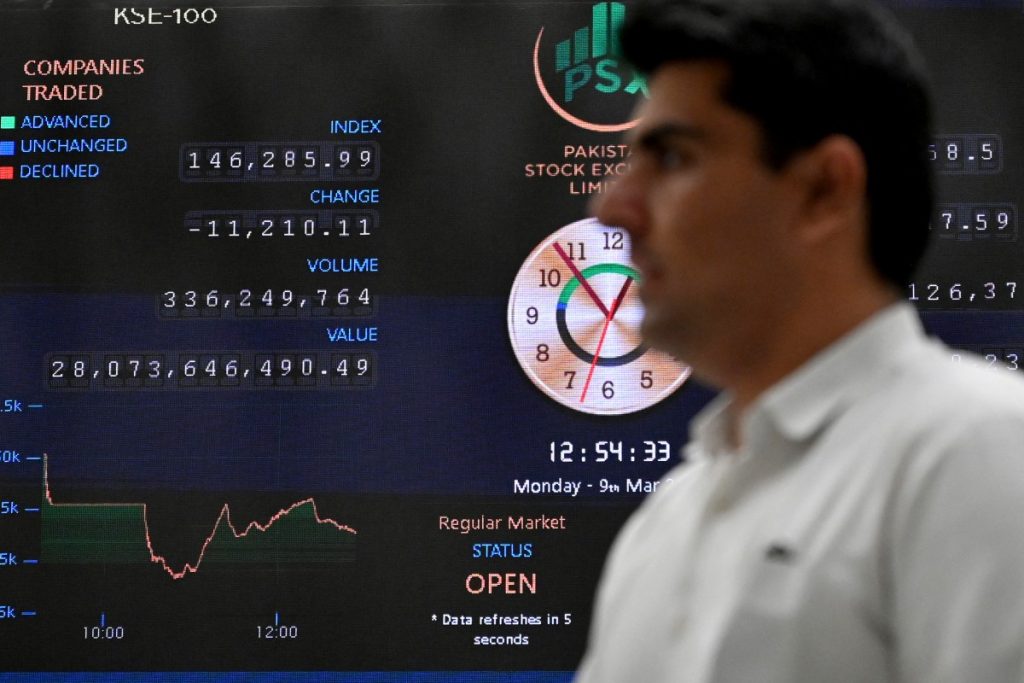
Stocks Decline as Oil Prices Surpass $100 Amid Middle East Conflict
Stock markets experienced significant declines on Monday as rising energy prices, driven by supply disruptions from the ongoing conflict in the Middle East, raised concerns about inflation.
Oil prices surged above $100 per barrel for the first time since Russia’s invasion of Ukraine in 2022, amid retaliatory strikes by Iran against oil-producing nations in the Gulf region.



U.S. President Donald Trump commented over the weekend that the price increase was a “small price to pay” to mitigate Iran’s nuclear threat, as hostilities show no signs of abating.
The escalation coincided with the appointment of Ayatollah Mojtaba Khamenei as Iran’s supreme leader, marked by missile strikes against Israel and Gulf states.
During Asian trading, international benchmark Brent crude oil and the U.S. West Texas Intermediate (WTI) saw prices rise significantly, initially up about 30 percent before settling at approximately 10 percent higher, around $100 per barrel as New York trading opened.
Although oil prices reached $130.50 per barrel following Russia’s invasion of Ukraine, the recent increases have been markedly steeper.
“Stocks are a sea of red today,” said Kathleen Brooks, research director at trading firm XTB.
While European markets managed to recover some of their earlier losses as oil prices moderated, Wall Street stocks opened down less than one percent, a smaller decline compared to futures trading.
Brooks noted, “The market has been somewhat calmed by the prospect of a coordinated release of strategic oil reserves by the G7. However, there remain concerns that any measures taken may only offer temporary relief.”
Discussions among the Group of Seven industrial nations are focusing on the potential release of emergency oil reserves, a move prompted by the near-complete halt of maritime traffic in the Strait of Hormuz, through which one-fifth of global crude oil is transported, since the conflict began on February 28.
Lee Hardman, an analyst at Mitsubishi UFJ Financial Group, stated that any release from strategic reserves would cover two to three weeks of typical supply through the Strait of Hormuz, representing a short-term solution aimed at preventing further price surges.
Market participants are increasingly worried that escalating energy prices could trigger inflationary pressures and hamper economic growth. Hardman commented that the rising oil prices are significantly increasing the risk of stagflation, characterized by high inflation and stagnant economic growth, potentially leading to a deeper sell-off in global equity markets.
The anticipation of sustained or increased interest rates to combat inflation resulted in higher government bond yields on Monday.
In Asia, major markets faced declines, with Seoul’s Kospi down six percent, Tokyo’s Nikkei 225 falling more than five percent, and Taipei decreasing over four percent. Hong Kong and Shanghai also recorded notable losses.
Key Market Figures Around 1:30 PM GMT:
- Brent North Sea Crude: Up 10.3 percent at $102.23 per barrel
- West Texas Intermediate: Up 9.6 percent at $99.61 per barrel
- New York — Dow: Down 0.9 percent at 47,086.58 points
- New York — S&P 500: Down 0.8 percent at 6,686.21 points
- New York — Nasdaq Composite: Down 0.7 percent at 22,234.64 points
- London — FTSE 100: Down 0.9 percent at 10,196.74 points
- Paris — CAC 40: Down 1.7 percent at 7,854.78 points
- Frankfurt — DAX: Down 1.0 percent at 23,349.68 points
- Seoul — Kospi: Down 6.0 percent at 5,251.87 (close)
- Tokyo — Nikkei 225: Down 5.2 percent at 52,728.72 (close)
- Hong Kong — Hang Seng Index: Down 1.4 percent at 25,408.46 (close)
- Shanghai — Composite: Down 0.7 percent at 4,096.60 (close)
Currency exchange rates reflected volatility, with the euro down at $1.1571, the pound at $1.3378, and the dollar rising against the yen at 158.29.
As global investors navigate these challenges, the implications of rising oil prices and potential economic repercussions remain focal points of concern.