Did Adeleke comply with Wike’s orders to protect his victory?
Election Aftermath Raises Questions About Political Dynamics in Nigeria
By Juliet Umeh
What unfolds after votes are counted and an election is declared won can significantly influence the trajectory of democracy in Nigeria. Recent comments by Nyesom Wike, the Minister of the Federal Capital Territory, have spotlighted this issue in the context of Governor Ademola Adeleke’s re-election in the August 15 Osun State gubernatorial election.

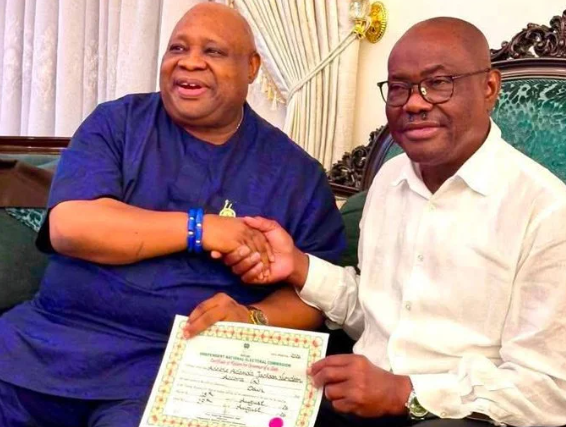
Wike disclosed that he instructed Adeleke to publicly reaffirm his support for President Bola Tinubu, express gratitude for what he characterized as a free and fair election, and formally present his Certificate of Return to the President. This revelation, made during a press event in Port Harcourt on Wednesday, has prompted reflection on how Nigeria’s democracy may be shaped not only by voters and electoral institutions but also by political dealings among influential figures.
During the media briefing, Wike recounted his concerns prior to the election. “If Adeleke wins, will he still support Mr. President?” he said he pondered. He clarified that he reached out to Adeleke, reminding him of a prior commitment to support Tinubu. “I called him and wished him good luck after hearing he would keep his word,” Wike stated.
The dialogue continued post-election. Wike, while in Croatia, again emphasized the importance of a public statement from Adeleke reaffirming his allegiance to Tinubu. “Now that you have won, issue a statement,” he advised. Following Wike’s recommendation, Adeleke met with Tinubu to hand over his Certificate of Return.
Wike characterized his intervention as a strategic move to limit the electoral influence of the African Democratic Congress (ADC) following Adeleke’s victory. “To knock off these people you call coalition…” he remarked, indicating his intent to prevent any political advantage for the ADC. His comments have led to deeper inquiries about the intersection of voter mandates and political negotiations.
Political analyst Prof. Anthony Kila, director-general of the Centre for International Advanced and Professional Studies, asserted that this situation highlights a more profound issue within Nigeria’s political framework. He expressed discomfort with the increasing personalization of politics, noting that it could undermine democratic principles. “Politics should be based on policies and ideas, not personal relationships,” he cautioned.
The implications of Wike’s assertions extend beyond personal exchanges, as many have taken to social media to question why an elected governor would need to reassure the President of his allegiance after securing a mandate from the electorate. Some view Adeleke’s actions as politically pragmatic, while others perceive it as indicative of the growing sway of political alliances over elected officials.
Concerns also persist regarding public trust in electoral institutions and the judiciary. Critics argue that political leaders might favor negotiations over risking their mandates in potentially prolonged legal disputes. Notably, there is no evidence suggesting that the All Progressives Congress (APC) abandoned any legal challenge because Adeleke followed Wike’s counsel. Following the election, the Osun APC stated it was considering its options and consulting legal advisors regarding potential actions.
Kila highlighted how the mere perception that a governor might need to negotiate politically for stability can be damaging. “The idea that personal ties might influence political survival signifies institutional deficiencies,” he noted, suggesting a lack of confidence in democratic systems.
Furthermore, Kila criticized the opposition for not providing a firm counterbalance to the ruling party, stating that a vibrant opposition is essential for holding the government accountable. “When the opposition is not visible, the government tends to abuse the system,” he explained.
The Wike-Adeleke discourse raises critical questions about the robustness of Nigeria’s democracy—whether elected officials can confront power without fear of repercussions, whether opposition parties can challenge and scrutinize the government effectively, and whether citizens can rely on electoral bodies and courts to uphold their votes.
As citizens cast ballots in public, the underlying concern remains: who truly holds power in Nigeria—the voter, the institutions, or the political negotiators operating behind the scenes?