Anti-party claims:Wike, Soludo, Adeleke fight back
Political Alliances Raise Concerns within Opposition Parties Ahead of 2027 Elections
By Luminous Jannamike, Dickson Omobola, Henry Obeta & Esther Onyegbula
The decision by several opposition governors to support President Bola Tinubu’s re-election campaign has sparked discussions about loyalty, political survival, and the opposition’s ability to unite ahead of Nigeria’s 2027 general elections.


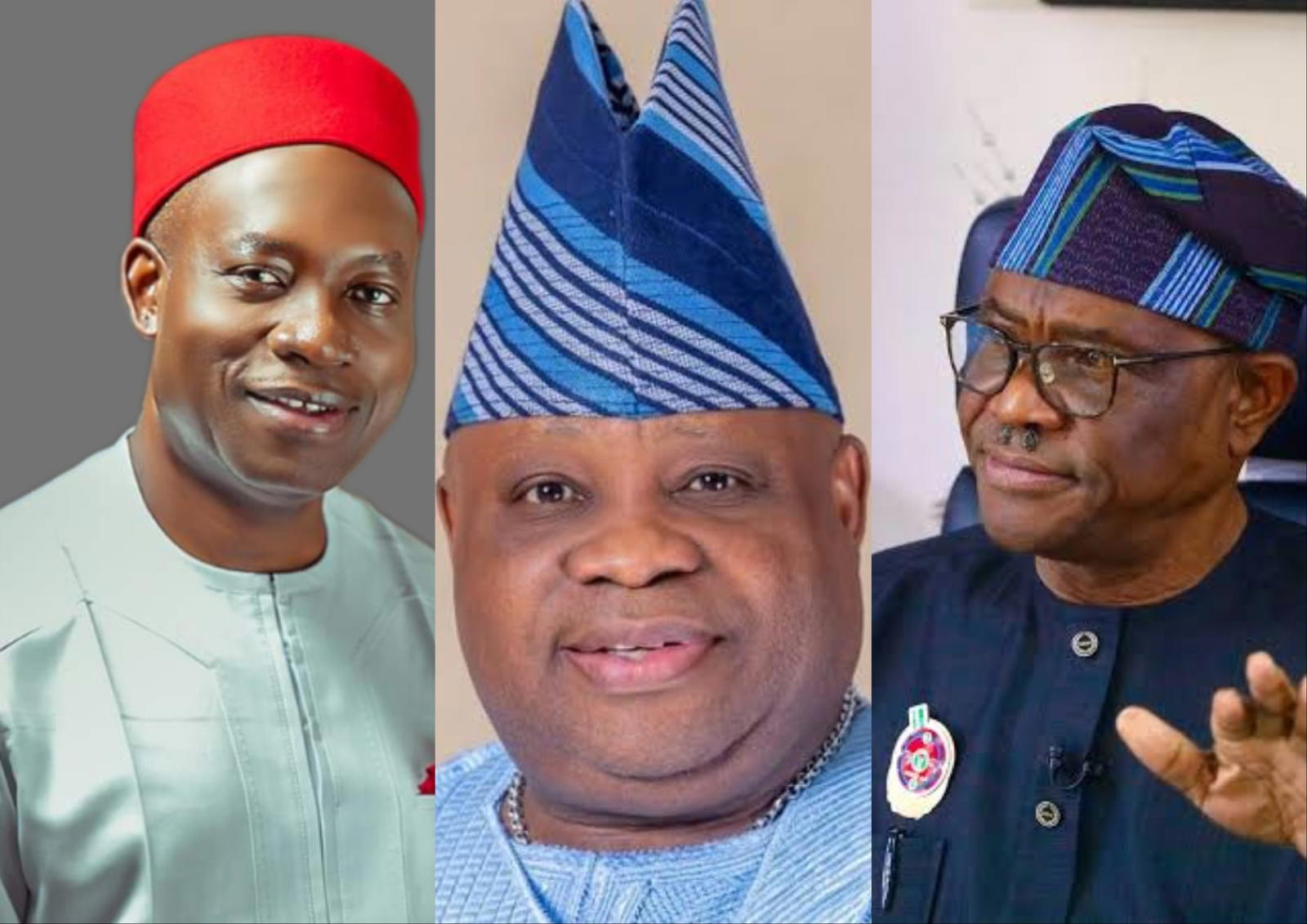
Key figures in this political landscape include Nyesom Wike, Minister of the Federal Capital Territory (FCT) and a member of the Peoples Democratic Party (PDP); Chukwuma Soludo, Governor of Anambra State and a member of the All Progressives Grand Alliance (APGA); and Ademola Adeleke, Governor of Osun State representing the Accord Party.
Investigations by Sunday Vanguard indicate that their choices have placed their respective parties in precarious positions, as they confront the ramifications of supporting the ruling All Progressives Congress (APC).
Internal Conflicts
Wike, a prominent leader within the PDP and former governor of Rivers State, continues to back Tinubu amid ongoing strife within the PDP and tensions with party members who oppose his stance. Soludo faces his own set of challenges as he balances his political ties with the President while staying loyal to APGA, which has its electoral ambitions. Similarly, Adeleke’s association with the Tinubu administration raises questions about the political strategies influencing his decisions and their effects on the Accord Party.
While the specific situations of these politicians vary, their actions have sparked debate about whether support for a rival party undermines the foundational platforms on which they built their careers. As the 2027 elections approach, these developments test the ability of the PDP, APGA, and Accord Party to manage internal disagreements and uphold their political identities while defining acceptable conduct for their members.
The situation also casts doubt on the strength of party discipline in Nigeria, where political affiliations often shift based on individual interests and strategic considerations.
Constitutional Implications
The constitutions of the involved parties outline potential anti-party activities. According to Section 10(6) of the PDP Constitution, members are prohibited from aligning with other parties to undermine the PDP or its elected officials. This provision underpinned the party’s August 2025 warning against public endorsements of Tinubu’s candidacy, supported by Section 59(1) regarding anti-party conduct.
Debo Ologunagba, the PDP’s National Publicity Secretary, confirmed that the National Working Committee reviewed the endorsements, stating, “We have seen anti-party activities from certain members, particularly those supporting President Bola Ahmed Tinubu for re-election in 2027.”
Likewise, APGA’s Constitution, notably Article 21, establishes sanctions for members whose actions bring disrepute to the party. The Anambra State chapter of APGA warned members in August 2022 against campaigning for candidates from other political parties, deeming such actions anti-party activities. Accord Party’s Constitution also labels engaging in anti-party activities as a violation, with provisions allowing dismissal for such conduct.
Despite these stipulations, Wike, Adeleke, and Soludo have publicly aligned with Tinubu’s campaign while also supporting candidates within their parties.
For example, Wike affirmed his backing for Tinubu at the APC Presidential Campaign Council’s inauguration on October 14, 2026, where he was named coordinator of the campaign in Rivers State and the FCT. He later encouraged Adeleke to publicly support Tinubu following his re-election.
Similarly, Soludo attended the APC campaign council launch and asserted that APGA would not run a presidential candidate, endorsing Tinubu’s reelection effort. He expressed his friendship with the President and accepted a role as campaign coordinator in Anambra.
Adeleke, in his remarks at the APC event, pledged to rally support for Tinubu, stating, “Let us rise from every nook and corner to support the President.”
Party Responses
When approached for comments, party leaders provided mixed responses. PDP spokesman Jungudo Haruna Mohammed defended Wike, asserting that he holds the right to endorse any candidate and that his actions do not conflict with his party affiliation, as he operates under an established agreement with the PDP.
“Wike has every constitutional and democratic right to decide whom he supports politically,” Mohammed stated.
In a similar vein, APGA National Chairman Sly Ezeokenwa characterized Soludo’s actions as a strategic alignment in line with party decisions and the interests of the South-East region.
“This alignment serves to ensure that our region benefits from the federal government,” Ezeokenwa said.
Michael Oke, Chairman of the Accord Party in Ogun State, expressed concerns regarding premature conclusions about Adeleke’s involvement with Tinubu’s campaign. He emphasized the need for the party leadership to assess the situation thoroughly before determining if any actions were anti-party.
Bamidele Salam, an Accord Party chieftain, welcomed Adeleke’s campaign role, stating that the party would mobilize significant votes for Tinubu.
Some civil society organizations criticized opposition party leaders’ attempts to rationalize these political maneuvers. Dr. Fredrick Manaseh, Country Lead of the Society for Promotion of Democratic Values and Ethos, argued that such actions compromise party integrity and democracy itself.
He noted, “When a party neglects its constitution for personal ambitions, it undermines its growth and credibility.”
Prof. Usman Monde, Executive Director of the Centre for Accountability and Good Governance, echoed these concerns. He remarked that political parties must enforce their own rules consistently and hold all members accountable, regardless of status.
As the political landscape evolves, questions remain about the loyalty of opposition figures and whether their actions signify a broader challenge to party cohesion as Nigeria approaches its next presidential election.