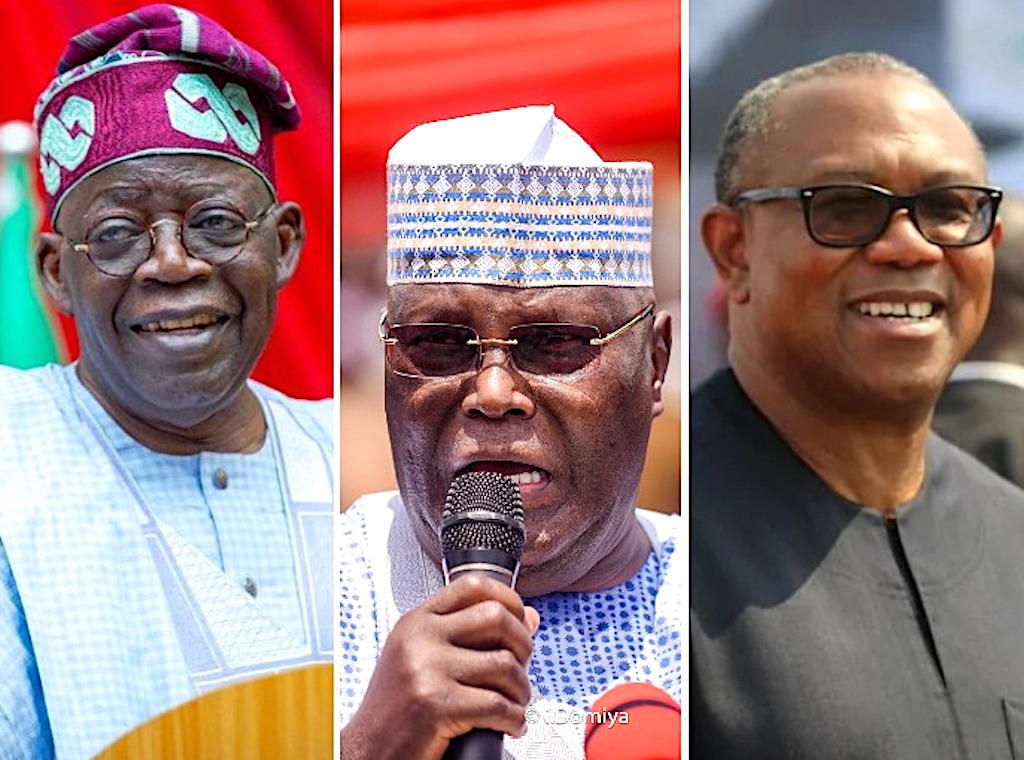
TINUBU, ATIKU, OBI: Battle for North’s votes intensifies

By Luminous Jannamike, Abuja
ABUJA — Political discussions in Nigeria’s capital often extend beyond routine exchanges, shaping the broader narrative of the nation’s political landscape. Within the city’s hotels, private homes, and party offices, influential figures such as governors, former ministers, and lawmakers engage in discreet negotiations that could have lasting implications.
Strategic alliances are tested during breakfast meetings, political futures are debated in quiet conversations, and a single public statement can shift the dynamics of candidates eyeing the presidential race in 2027.
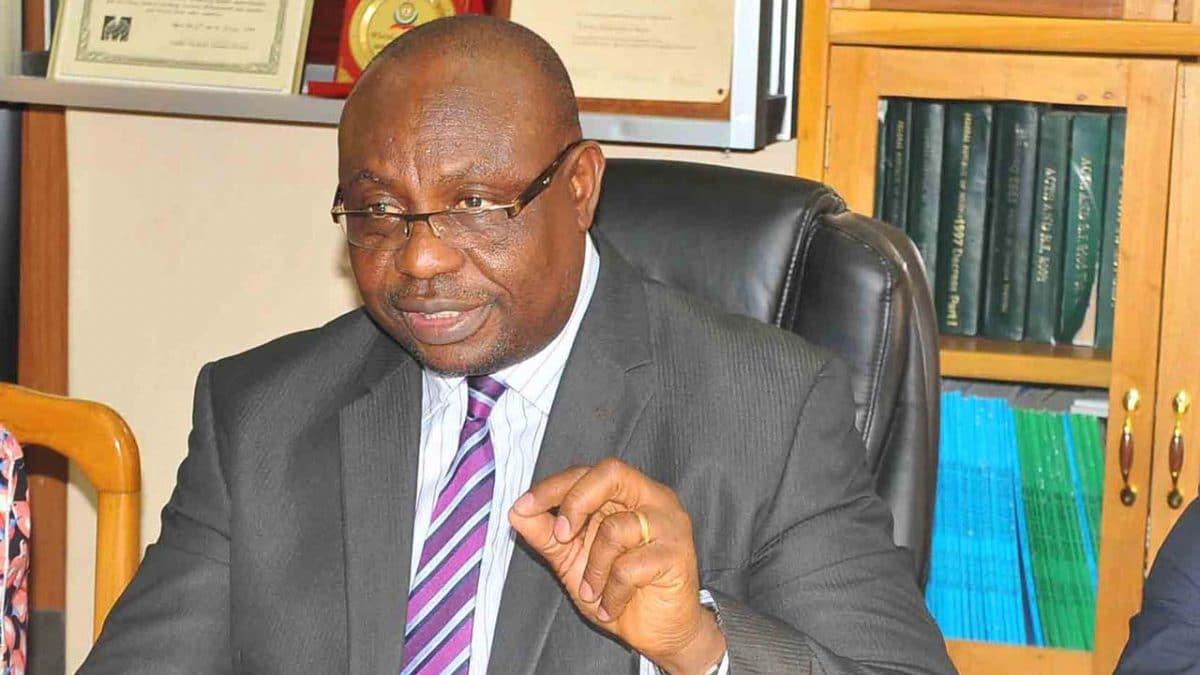
One such pivotal exchange occurred recently between former Kano State Governor Rabiu Musa Kwankwaso and former Borno State Governor Ali Modu Sheriff. In an interview on Channels TV’s “Politics Today,” Sheriff claimed that Northern voters would not support Peter Obi, a notable presidential contender. Kwankwaso countered this assertion, stating that no single individual can represent the collective voice of the North.
This disagreement spurred extensive coverage across television and newspapers, igniting discussions within political circles. Experienced analysts noted that the disagreement extended beyond Obi; it raised a fundamental question about who, following the presidency of Muhammadu Buhari, can truly comprehend or command the political heartbeat of Northern Nigeria—a question central to the electoral strategies of many candidates.
Historically, politicians have characterized the North as a unified electoral stronghold capable of delivering substantial votes to any candidate winning its allegiance. Since Buhari’s departure from office, this perception has transformed into a form of political folklore. Across party lines, aspirants routinely reference the enduring legacy of “Buhari’s 12 million votes,” viewing it as either a significant political inheritance or an outdated myth.
Perpetuating a Political Myth
Before becoming synonymous with Northern political might, Buhari’s electoral appeal was cultivated over years of opposition politics. His image resonated with countless Northerners who viewed him as a disciplined leader with integrity, willing to confront a political establishment perceived as disconnected from the public’s daily struggles.
In states such as Katsina, Kano, and Zamfara, Buhari’s campaign elicited an emotional response, with supporters identifying with his movement against issues like poverty and insecurity. Despite repeated electoral failures in 2003, 2007, and 2011, his supporters remained steadfast, believing he represented a viable alternative to a political order that had consistently disappointed them.
It was during this time that the phrase “Twelve million votes” crystallized—a political shorthand that has gained considerable weight over the years, despite the complexities of the electoral realities.
Examining the Numbers
Data from the Independent National Electoral Commission (INEC) reveals that while Buhari’s popularity was significant, it was context-dependent. In the 2003 presidential election, he garnered over 12 million votes, establishing himself as a prominent opposition figure with substantial support from the North-West and North-East regions.
However, this perception began to wane during the 2007 election, where his vote tally fell to just over six million after competing against a fellow Northerner, Umaru Musa Yar’Adua. This decline highlighted that political loyalty can be influenced by various factors beyond mere regional affiliation.
Buhari’s reinvigorated support in 2011 saw him once again exceed 12 million votes, ultimately culminating in his 2015 victory due to a coalition of opposition parties that significantly reshaped Nigeria’s political landscape. His later re-election in 2019 demonstrated the strength of this coalition rather than an unassailable personal following.
Diversity Within the North
The long-standing tendency to depict “the North” as a singular political entity overlooks its rich diversity. Historical rivalries, from the Northern People’s Congress to the Northern Elements Progressive Union, illustrate that Northern politics have never been monolithic.
As various political movements emerged and evolved—evident in party formations from the Second Republic onwards—regional differences continued to shape electoral behavior. Today, identity, economy, education, security, and religious issues influence voter preferences, reflecting a complex political landscape that is increasingly fragmented.
Recent developments, including the rise of Kwankwasiyya in Kano and the elevation of insecurity as a critical issue in the North-East, highlight this growing complexity. As urban centers expand, a new generation of voters prioritizes economic opportunities and governance over traditional political allegiances.
Implications Going Forward
As Nigeria approaches the 2027 elections, major political parties recognize Northern Nigeria’s significance as a battleground. The APC asserts its advantages through incumbency and governance, while opposition coalitions seek to capitalize on public dissatisfaction and economic discontent. Each faction approaches the electorate with its own strategies, but they must contend with a reality: Northern Nigeria no longer conforms to a single political narrative.
Kwankwaso’s and Sheriff’s exchange epitomizes this ongoing evolution. One leader insisted on the impossibility of one person claiming the North’s voice; the other leaned on established assumptions. The disparate viewpoints underscore the uncertainty that will define Nigeria’s next presidential election.
Outside the confines of political negotiations, a broader narrative is forming in market squares and farming communities, where issues of economic hardship and security loom large. Political influence is increasingly assessed on the basis of governance capabilities rather than inherited loyalties.
As Nigeria transitions into the post-Buhari era, the prevailing question may no longer be who inherits the mythical “12 million votes,” but whether the North has indeed entered a new age of political engagement—one that prioritizes leaders who can authentically earn the trust of a diverse electorate.