We may have missed our way again on democracy – Saraki
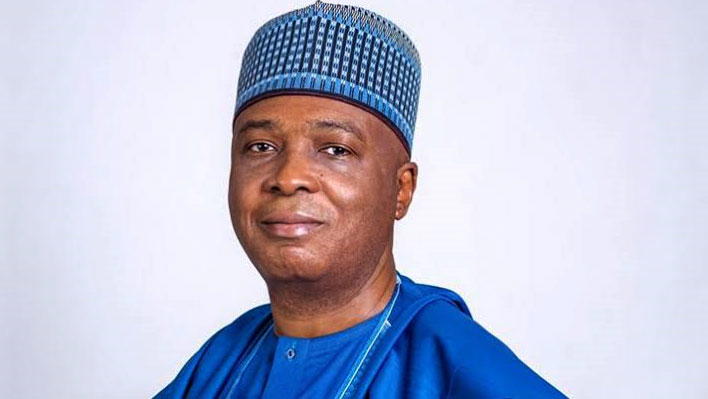
Saraki Advocates for Stronger Legislative Institutions on Democracy Day
By Olayinka Latona
Former Senate President Bukola Saraki emphasized the critical role of the National Assembly in safeguarding Nigeria’s democracy during a speech at The Platform Nigeria, an event commemorating Democracy Day. He argued that the legislature serves as the “load-bearing wall” of democracy and must be fortified to prevent a recurrence of the June 12, 1993, electoral crisis—a moment he described as a significant yet overlooked date in Nigeria’s national memory.
In his address, Saraki recalled the historic 1993 elections, where Nigerians cast their votes in a united expression of democracy, only to have the mandate annulled. He stressed that lives were lost in defense of that democratic choice, underscoring the resilience of citizens who, year after year, honored June 12 as a day of significance.
“Democracy in Nigeria was never handed to us. It was fought for,” Saraki stated, urging the audience to cherish and protect democratic ideals. He divided his discussion into three main themes: ensuring democratic stability, enhancing governance, and promoting national development through a robust legislature.
Saraki acknowledged a common misconception among Nigerians regarding the relationship between the executive and legislative branches. He noted that many associate power solely with the presidency, often undermining the importance of the National Assembly.
“The greatest danger to a free people is not a weak government, but an unchecked government,” he warned, asserting that the Constitution was designed to create a system of checks and balances. “That friction is not dysfunction. It guarantees your freedom,” he added.
Addressing his tenure’s criticism regarding the Senate’s independence from the executive, Saraki reinforced that legislative independence does not equate to rebellion against the government. Instead, he argued that a robust National Assembly bolsters legitimate governance.
Saraki drew connections between the annulment of the June 12 election and the weakness of institutions meant to defend democracy. “We did not lose democracy in 1993 because the people failed,” he said. “We lost it because the institutions were too weak.”
The former Senate President further criticized narratives that accuse the National Assembly of “padding” budgets when it modifies executive proposals, asserting that such actions are constitutional responsibilities. He highlighted instances of executive overreach, suggesting that inadequate executive compliance with legislative authority can set dangerous precedents.
In a personal revelation, Saraki shared his experiences regarding the Senate’s rejection of the acting chairman of the Economic and Financial Crimes Commission (EFCC), noting that he and others faced backlash for asserting their confirmation powers.
Saraki’s discourse also included examples of how the legislature impacts citizens’ lives, citing stories of individuals who benefited from parliamentary intervention in their cases. He also pointed out that many of Nigeria’s laws, some enacted in the 1970s, require modernization to suit contemporary business and governance needs.
While defending the legislature, Saraki acknowledged its imperfections, admitting that it can seem detached from the electorate. He urged citizens to hold their representatives accountable through electoral reform, emphasizing the need for a political process that allows the right individuals to be elected.
As he concluded his remarks, Saraki reiterated that strong legislatures are not adversaries of the state but integral to stable governance. “Democracy is not a single election or a single office. It is a daily act of tending to it and ensuring it survives,” he said. He proposed a formula for strengthening Nigeria’s democratic framework: “A strong legislature promotes transparency. Transparency inspires public trust. Public trust strengthens democratic legitimacy. And democratic legitimacy produces stability.”
The event underscored Saraki’s belief that a resilient National Assembly is vital for the nation’s democratic future.